EU, US officials unmoved by litigation potentially impacting Data Privacy Framework
Trump v. Slaughter does not breach the EU-U.S. DPF's independent regulator requirements, according to representatives from both governments.
Contributors:
Joe Duball
News Editor
IAPP
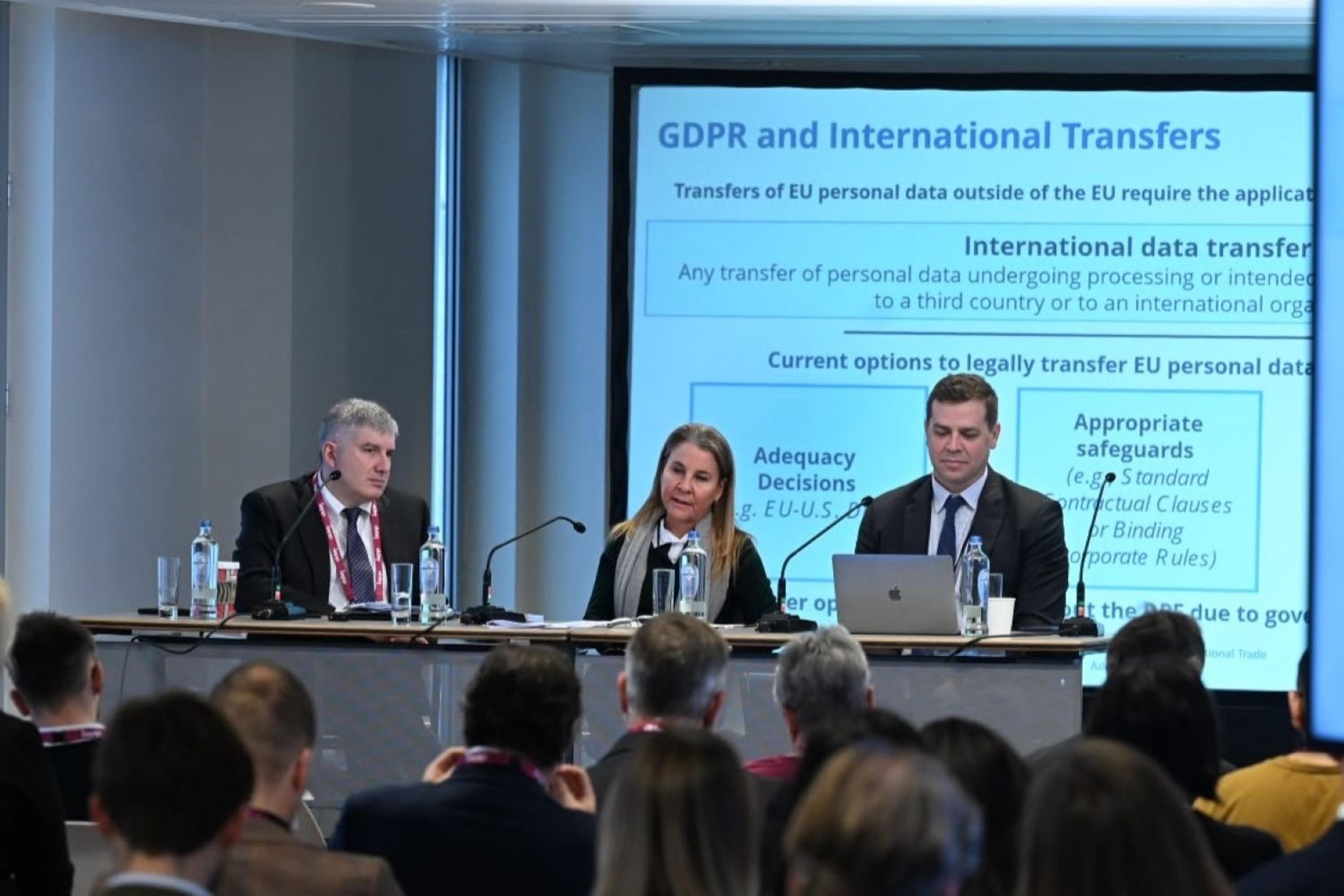
Officials overseeing both sides of the EU-U.S. Data Privacy Framework are confident recent and ongoing legal developments are not jeopardizing the data transfer agreement's validity. Speaking at the IAPP Europe Congress 2026, U.S. Department of Commerce's International Trade Administration Data Privacy Framework Director Alex Greenstein and European Commission acting Head of Unit for Rule of Law and Equality, International Affairs and Data Flows Louisa Klingvall each agreed that the U.S. Supreme Court's Trump v. Slaughter ruling is not a threat to the core functions of the DPF, which came online in 2023 following court-ruled invalidations of two predecessor transfer agreements.
The decision to uphold the removal of former U.S. Federal Trade Commissioner Rebecca Kelly Slaughter by President Donald Trump without cause raised stakeholder questions regarding the regulator independence required under the DPF.
"We don't see any sort of practical impact from that decision or changes in the FTC's role," Greenstein said. "The FTC and its commissioners remain fully able and obligated to enforce the FTC Act. ... Their authority to police those public commitments companies have made under the DPF remains."
He pointed to evidence of the "continuity" for the FTC, including existing consent decrees the agency has put into place and "commitment letters" sent to the European Commission. From Greenstein's point of view, the ruling largely touched on the "interrelationship" and "inner workings" of the U.S. government.
Invalidation of the agreement would undo several years of buildup, with the DPF carrying more than 3,700 participating entities as of November 2026, according to the Department of Commerce.
Among the concerned stakeholders was the European Data Protection Board, which urged the Commission to review the DPF following the court's decision. In a letter requesting the evaluation, EDPB Chair Anu Talus highlighted the DPF's explicit references to FTC independence and a U.S. president's ability to remove a commissioner only for "inefficiency, neglect of duty, or malfeasance in office."
It is unclear how the Commission responded to the July request, though Klingvall indicated the situation is under "ongoing assessment" with U.S. officials involved. She mostly echoed Greenstein's confidence that the ruling would bring no consequences for the DPF despite the "worrying signals channeled on this."
"What I can already say is it is chiefly related to the commercial side of the DPF rather than the government access side," Klingvall added. "This is a very important clarification. In particular, that this judgement doesn't affect the other data transfer tools that are available under the (EU General Data Protection Regulation)."
Article 46 of the GDPR provides for the use of standard contractual clauses, binding corporate rules, codes of conduct or data protection certification. Klingvall highlighted that those mechanisms "rely on the oversight and enforcement by other institutions."
Additionally on the question of real impact, Greenstein noted while the FTC plays a crucial role in the DPF, many steps occur before individual complaints land with the agency.
"A company really has to have admitted some fairly serious malfeasance in order for it to reach that level," he said. "First the company has to respond to an individual complaint. You have the independent recourse mechanism, which can resolve issues. You have the binding arbitration mechanism. So you really have to not be addressing all of these for it to finally end up reaching the FTC."
DLA Piper Senior Policy Advisor Dan Caprio, who previously worked on EU-U.S. data transfer matters at the FTC and the Department of Commerce, commented to the room following the panel discussion that the discourse around the impacts of the Supreme Court's ruling have created a "false flag" and officials need to "continue to see this through."
"The issue is not a surprise. The FTC, which was formulated in 1914, has just amassed a lot of executive authority, and that's what was undone by (this case)," Caprio said.
EU-based challenges still looming
Beyond Trump v. Slaughter, the DPF still faces a level of uncertainty via EU complaints.
Member of French Parliament Philippe Latombe is awaiting a Court of Justice of the European Union ruling on the European General Court's dismissal of claims seeking to annul the DPF. The challenge focused on the independence of the U.S. Data Protection Review Court, a key DPF redress component, and alleged insufficient safeguards over bulk data collection by U.S. intelligence agencies without prior authorization.
Additionally, NOYB Honorary Chair Max Schrems previously told the IAPP in August that his legal team was drafting their latest challenge to the DPF following his cases led to the invalidation of both EU-U.S. predecessor frameworks. He has not formally lodged the latest complaint, but it will be on grounds that Trump v. Slaughter allegedly breached the Charter of Fundamental Rights of the European Union, as well as the creation of potential political conflicts of interest.
Klingvall indicated the Commission is always braced for legal challenges and they are "part of any legislative activity in a healthy system."
Specifically on the Latombe case, she characterized the complaint as "very wide" and the General Court tossed the entirety of his claims.
"We're just going to have to wait patiently for the court to pronounce," Klingvall added. "But what I can say from our side is we will continue to defend the system that we have put in place."
This content is eligible for Continuing Professional Education credits. Please self-submit according to CPE policy guidelines.
Word count: 874

Contributors:
Joe Duball
News Editor
IAPP