AI Legal Ethics and Responsibilities Tracker
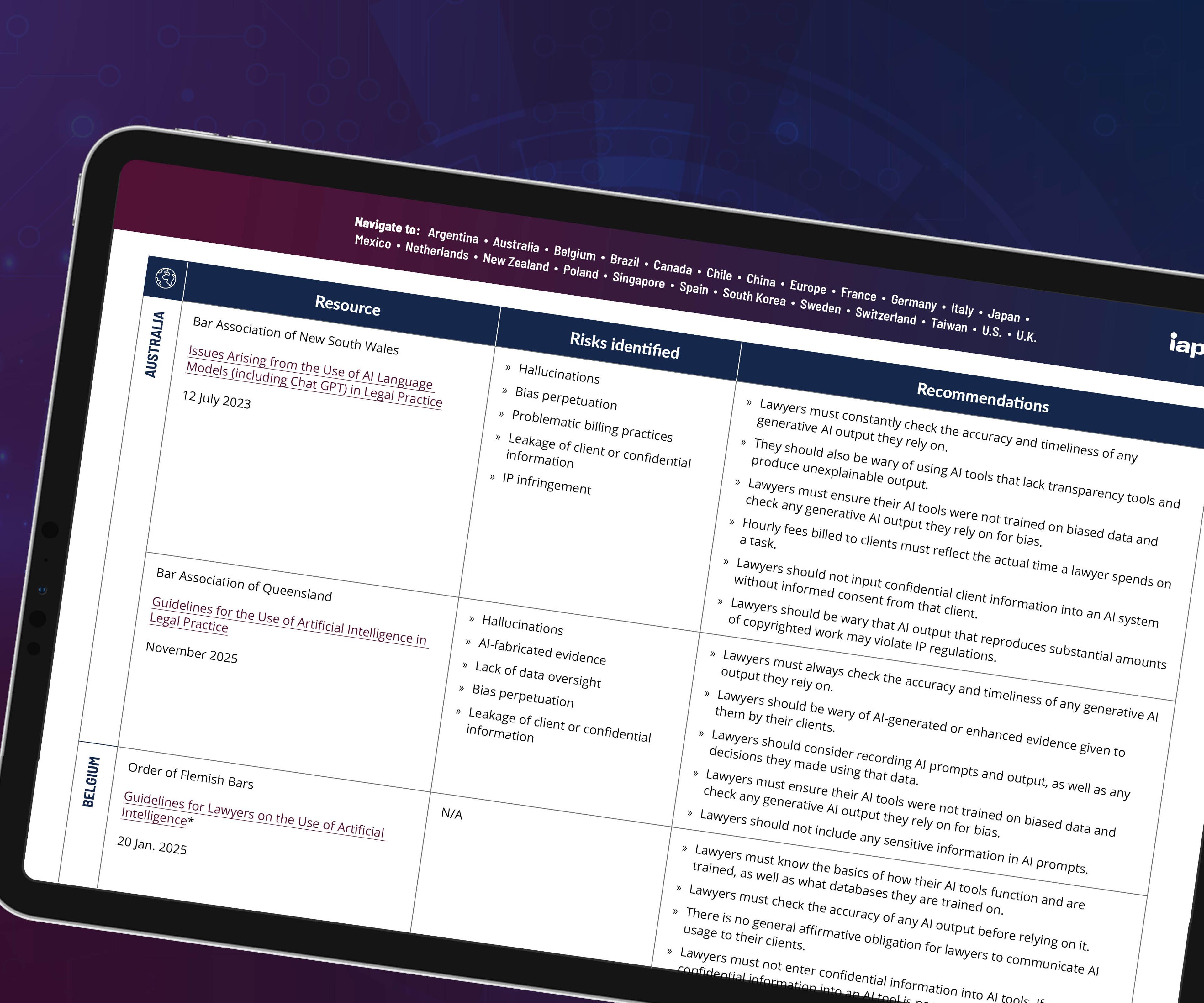
This tracker explores how legal professional bodies and courts worldwide are shaping the ethical and responsible use of AI in law.
Contributors:
Vasilios Antonopoulos
Westin Fellow
IAPP
Müge Fazlioglu
CIPP/E, CIPP/US
Principal Researcher, Privacy Law and Policy
IAPP
Joe Jones
Research and Insights Director
IAPP
Numerous state and national bar associations and other professional bodies have issued guidance, both formal and informal, on the use of artificial intelligence in legal services. These guidelines seek to answer questions such as how AI use should align with the ethical standards of the legal profession, how the risks and benefits of AI use ought to be balanced and what practical steps lawyers and law firms need to take before implementing AI in their daily practices.
Courts and judiciary bodies have been confronted with a similar proliferation of questions, putting forth guidance and orders on implementing AI in their courtrooms, as well as the common pitfalls regarding generative AI use that judges and court personnel should be particularly aware of. They have also issued numerous orders concerning the use of AI-generated material in legal proceedings and court filings. In response to the increasing use of AI-generated evidence in court, these rules and guidelines seek to help judges determine the authenticity, validity and reliability of evidence in the era of AI.
The AI Legal Ethics and Responsibilities Tracker consolidates these emerging guidelines, orders and rules, identifying the risks with AI use as well as documenting key recommendations and emerging legal standards and obligations. This collection of AI guidance is organized jurisdictionally and alphabetically by country.
Overall, this tracker makes clear that AI has both enhanced and complicated the range of duties legal professionals must carry out. As the duty of competence may extend to the use of AI, the professional obligations brought about by AI must be addressed. It is within this current legal environment, increasingly transformed by AI, that legal professionals must grapple with how to incorporate AI into the practice of law in an ethical and beneficial manner.
This content is eligible for Continuing Professional Education credits. Please self-submit according to CPE policy guidelines.

Contributors:
Vasilios Antonopoulos
Westin Fellow
IAPP
Müge Fazlioglu
CIPP/E, CIPP/US
Principal Researcher, Privacy Law and Policy
IAPP
Joe Jones
Research and Insights Director
IAPP
Tags: