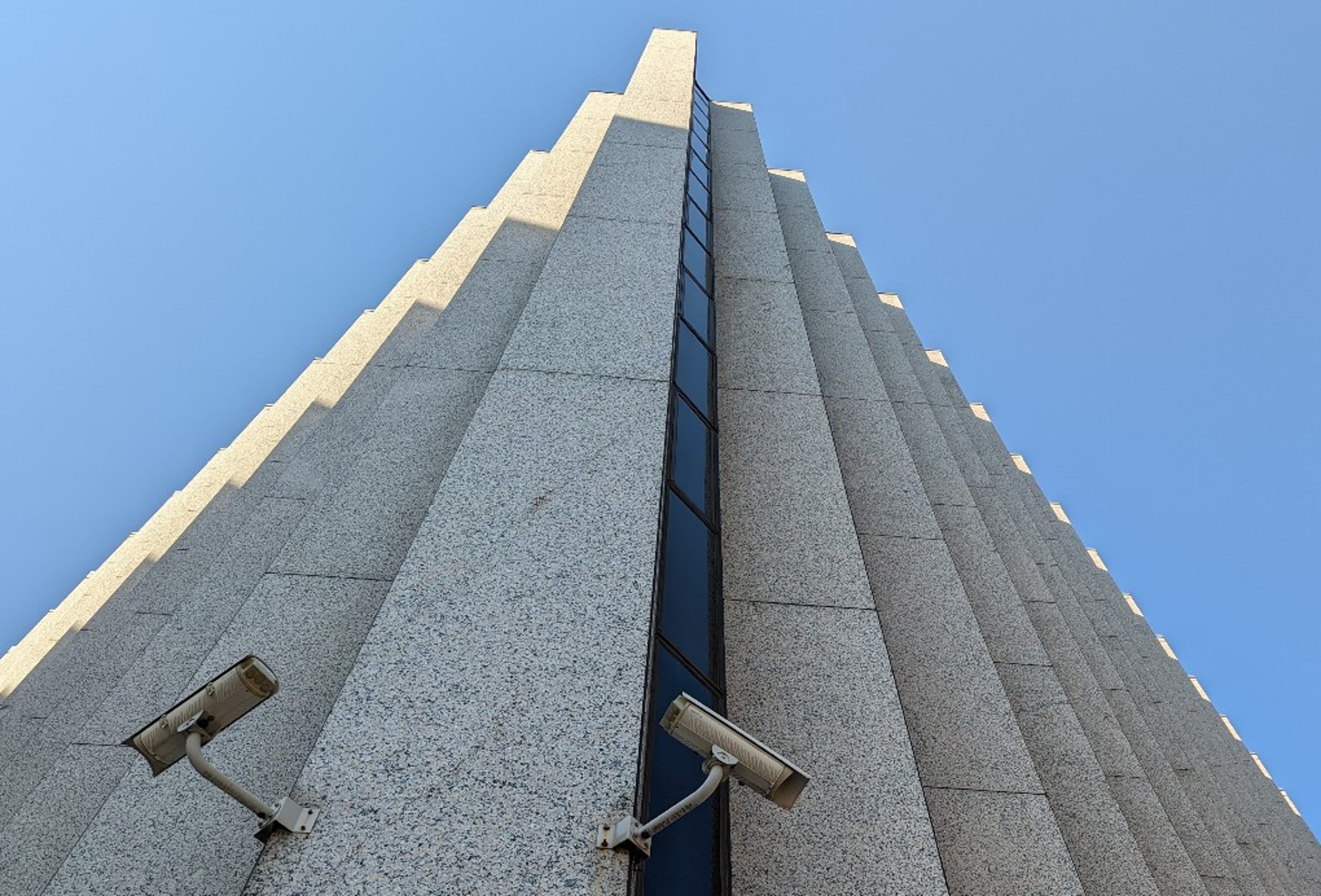
US senators flag unease over commercial surveillance cameras

The U.S. Senate Committee on the Judiciary Subcommittee on Crime and Counterterrorism heard testimony on the privacy risks network-connected commercial surveillance cameras pose to law-abiding citizens.
Contributors:
Alex LaCasse
Staff Writer
IAPP
While the existential risks of runaway frontier AI development have recently captured much of the attention of members of U.S. Congress, several lawmakers are continuing to voice their concern over the sprawling commercial surveillance apparatus powered by a network of smart automated license plate readers integrated with artificial intelligence.
The U.S. Senate Committee on the Judiciary subcommittee on Crime and Counterterrorism held a hearing to discuss significant concerns of mass surveillance abuses and substandard cybersecurity of commercial-networked surveillance cameras, most notably those produced by Flock Safety, as well as companies, including Axon and Motorola, that make similar cameras.
The hearing suggested there is room for broad bipartisan consensus to at least reform how federal, state and local law enforcement access camera footage to aid in their investigations, if not an outright ban on the cameras altogether if lawmakers ultimately deem them too prone to abuse.
Subcommittee Chair Josh Hawley, R-Mo., said the network of Flock cameras alone in the U.S. has grown to approximately 120,000 individual cameras throughout 49 states. Citing Flock's own statistics, Hawley said the camera network captures approximately 20 billion images of individuals in their vehicles every month across the country.
"What makes these networks unique is not just the sheer number of cameras, it's the fact they’re all linked together and searchable (with) AI," Hawley said. "We've got to find a way to protect and enforce the Bill of Rights and the basic civil liberties of every law-abiding citizen in this country, no matter what the technology is, and I think that is the challenge that is facing us today."
Invited witnesses raised civil liberties and legal concerns, as well as those related to law enforcement abusing their access to Flock camera data. Hawley said the subcommittee also invited Flock Safety CEO Garrett Langley to testify, but he declined.
Explaining Flock's cyber vulnerabilities
Independent cybersecurity researcher Benn Jordan discussed his recent work investigating vulnerabilities in commercial surveillance cameras, including Flock. He first began researching Flock in 2025 after hearing claims the company did not require clients to use multifactor authentication.
Jordan said he found Flock videos accessed by police departments in the U.S. for sale by a Russian vendor on the dark web. Additionally, he was able to access or reprogram all data housed on most commonly purchased cameras "in under a minute" and "at the push of a button."
There was also access to "unprotected administrative interfaces" for 60 newly deployed Flock Condor cameras, which allowed Jordan to remotely view, delete and modify the prior 30 days of streaming camera footage in multiple devices. He was able to use the cameras' zoom feature to read text on cellphone screens of individuals passing within a specific camera's field of vision.
"I have been one of Flock's harshest critics for years, but everything I just stated about them is a symptom of a much larger problem," Jordan said. "What I've been asking for, around the country, is for privatized government surveillance vendors to require independent security testing and inspections. Axon and Motorola are actively rolling out the same reckless features that we're shaming Flock for, and you can expect these same vulnerabilities will continue to happen over and over again when innocent people's data is traded between private companies and police without any safeguard or protection."
Room for reform?
The questioning among subcommittee members then shifted to how or if the existing system of network-connected commercial surveillance cameras could be reformed.
Institute for Justice Legislative Counsel Alasdair Whitney said while a number of states have passed laws governing retention limits for license plate reader data, virtually none imposes a search warrant requirement on law enforcement agencies seeking to access any potentially relevant data for investigations. While a federal law creating a search warrant requirement is not a silver bullet, Whitney indicated some form of warrant requirements does add another layer of transparency that can make it easier for wrongly accused suspects to challenge cases on illegal search grounds.
"Frankly in most places (the problem is) limitless access," he said, responding to questions from senators. "What makes this different than ALPRs of yesteryear is that law enforcement can search this data right now with the ease of typing a Google search."
The evidence of law enforcement abusing its access to connected cameras and the data they collect is mounting.
Over the past several years, multiple police officers in departments across the country were found to use Flock video footage to stalk current and former domestic partners, or illegally surveil non-suspects, according to multiple media reports. Most recently, five Indianapolis Metropolitan Police Department officers were recently charged with stalking-related crimes for allegedly misusing the department's 300 Flock cameras, ABC News reported.
American Civil Liberties Union Senior Policy Counsel Chad Marlow questioned the value of such technology if it ostensibly violates law-abiding citizens' privacy in its day-to-day functions beyond the documented cases of illegal use. He also called on Congress to pass legislation to cut off federal funding to any law enforcement agency that continues use of modern ALPRs.
"The greatest threat that comes from a mass surveillance ALPR system is not when it is misused, but when it is used as designed," Marlow said. "The AI-empowered mass surveillance of every single American isn't an ALPR product defect — it is its most prominent and intended feature. All it takes is one officer in one department who is a customer of Flock and participates in their nationwide data sharing program and gets a call from ICE or any other federal agency asking for him to conduct a search (on their behalf)."
Law enforcement's perspective
Pinal County, Ariz., Sheriff Ross Teeple told subcommittee members his agency let its existing contract with Flock expire, despite touting the investigative value of using ALPRs to "solve crimes, catch dangerous criminals, and find missing people," even if they are restricted to solely capturing images of license plates. One of the main drivers of his decision was the lack of transparency about the cameras' capabilities.
For instance, Teeple said upon being elected to his post, his knowledge of ALPR technology was "20 years old," and sought to clarify the image resolution a Flock camera can capture after he was told it could not produce high enough resolution to recognize an individual person. He then reviewed captured Flock images on his agency's cameras and discovered that the cameras could, in fact, capture high-resolution images of people.
"There was too much disinformation and dishonesty coming from Flock's representatives," Teeple said. "If we rely on private camera networks to act as a dragnet, continuously logging the habits of innocent Americans without a warrant, we are paving the way to an AI-driven surveillance state. If we allow government-funded private surveillance companies to push this envelope blindly, we risk a sweeping judicial correction that could strip away the legitimate, life-saving aspects of ALPR technology entirely."
The damage being done
Lindsey Isaacs was arrested last year and charged with crimes related to causing a fatal accident in Florida after a Flock camera misidentified her vehicle as having been involved in the accident. Isaacs' vehicle was no where near the remote vicinity of the crash site at the time it occurred.
In her Senate testimony, Isaacs said she was placed in solitary confinement following her arrest due to the serious nature of the vehicular homicide-related charges and spent a total of 13 days incarcerated before the charges were later dropped. She admitted the ordeal led her to contemplate suicide while in detention.
"I was facing the possibility of spending the rest of my life in prison for a crash that I knew I had not been involved in," Isaacs said. "I want you to understand that surveillance technology does not exist in a vacuum. Information collected by technology can become part of an investigation that affects a real human being."
Subcommittee Democrats lamented the mass surveillance capabilities of network enabled cameras, but largely sought to maintain a balance between law enforcement's ability to use the cameras to aid in their official duties, while not sacrificing innocent peoples' privacy.
ALPRs "have been used to locate people who’ve gone missing, cars connected to crimes and stolen vehicles. That all sounds good," Sen. Dick Durbin, D-Ill., said. "We have got to find a way to balance privacy and security in America. Congress needs to lead the way."
'You ban them'
The ACLU's Marlow said the expansive and relatively convenient capabilities of Flock cameras and similar technologies are too prone to abuse to ensure they can be used in a manner consistent with civil liberties protections. He opined the only way to prevent informal and warrantless sharing of camera footage among law enforcement agencies is to ban the cameras altogether.
"Flock never acknowledges that no security procedures that are put in place do anything to protect against the misuse of the system," Marlow said, responding to questions from Sen. Alex Padilla, D-Calif. "If the question is how do we close that loophole? You ban them."

This content is eligible for Continuing Professional Education credits. Please self-submit according to CPE policy guidelines.
Submit for CPEs